
Study in Germany
Tuition-free public universities, Ausbildung dual training, and Europe's strongest job market
Country Overview
Why Study in Germany?
Germany is one of the most attractive study destinations in the world — combining world-class education with near-zero tuition fees at public universities. Students pay only a semester fee (€150–€500) for administration and public transport, making Germany by far the most affordable quality education destination among major economies.
For Indian students, Germany offers multiple pathways: university degrees (bachelor's, master's, PhD) in engineering, sciences, business, and technology; Ausbildung (dual vocational training) programs that combine classroom learning with paid practical training in companies; and nursing programs with structured hospital training that leads to direct employment.
Germany's economy is Europe's largest and consistently has high demand for skilled professionals, especially in engineering, IT, healthcare, and trades. Graduates benefit from an 18-month post-study job seeker visa to find employment in their field.
Quick Facts
- Language
- German (English programs available)
- Currency
- Euro (EUR)
- Climate
- Temperate: cold winters, mild summers
- Academic Year
- October & April intakes
- Time Zone
- CET/CEST (UTC+1/+2)
- Education System
- Bologna-compliant, research-focused
Top Reasons
Why Study in Germany?
Near-Zero Tuition Fees
Public universities in Germany charge only a semester fee of €150–€500 — for administration and public transport. The actual education is free for all students, including internationals.
World's Best Engineering Education
Germany is the birthplace of the modern engineer. TU Munich, RWTH Aachen, and KIT rank among the world's top technical universities. German engineering degrees are prized globally.
Ausbildung: Earn While You Learn
Germany's unique dual vocational training program combines classroom theory with paid practical work. Students earn €600–€1,200/month during training and gain an internationally respected qualification.
Nursing & Healthcare Pathway
Germany faces a critical shortage of healthcare workers. Indian nursing graduates receive structured training, hospital placements, and direct employment offers in Germany's well-funded healthcare system.
Central European Location
Studying in Germany gives you access to 26 Schengen countries visa-free and places you at the heart of the EU economy — perfect for those targeting a European career.
18-Month Job Seeker Visa
After graduation, you can stay in Germany for 18 months specifically to find a job in your field. Once employed, you can apply for a Blue Card or residence permit for long-term stay.
Interested in Germany Ausbildung?
Earn €600–€1,200/month while training. Germany's dual vocational system is a direct pathway to employment — no tuition, fully paid training.
Budget Planning
Study Costs in Germany
Transparent cost breakdown to help you plan your finances
🎓Tuition Fees
Public University (all degrees)
This includes access to public transport
Free + €150–500/semester administration fee
University of Applied Sciences
Free – €500/semester
Private Universities
€5,000 – €25,000/year
Ausbildung / Nursing Programs
You are paid to train
Free + monthly training stipend (€600–€1,200)
🏠Monthly Living Costs
Funding Opportunities
Scholarships to Study in Germany
We help you identify and apply for all scholarships you're eligible for — free of charge.
DAAD Scholarship (Development-Related Postgraduate Courses)
DAAD (German Academic Exchange Service)
Indian students with 2+ years professional experience applying for specific master's
Deutschlandstipendium
Federal Government + Private Sponsors
High-achieving students at German universities; merit-based
Heinrich Böll Foundation Scholarship
Heinrich Böll Foundation
Strong academic record + social/political engagement
Konrad Adenauer Foundation Scholarship
Konrad Adenauer Foundation
Outstanding students with civic engagement
Visa Guide
Germany Student Visa
We handle your complete visa documentation and application — 98% success rate.
Visa Type
National Visa (Type D) — Student Visa
Processing Time
4–8 weeks (German embassies in India are in high demand)
Application Fee
€75
Work Rights
120 full days or 240 half days per year (approx. 20 hrs/week during study)
Step-by-Step Application Process
- 1
APS Certificate (Indian Students)
All Indian students must obtain an APS (Akademische Prüfstelle) certificate verifying their academic documents. This process takes 4–6 weeks and involves an interview in Delhi, Mumbai, or Chennai.
- 2
Open a Blocked Account (Sperrkonto)
Open a Sperrkonto at Fintiba or Deutsche Bank India with €11,208. This money is released monthly in Germany and proves financial sufficiency for your student visa.
- 3
Apply for Admission
Apply to German universities via Uni-Assist (for most universities) or directly. For Ausbildung, find a company through the Federal Employment Agency (BA) portal.
- 4
Book Embassy Appointment
Book a student visa appointment at the German Embassy or Consulate in India (Delhi, Mumbai, Chennai, Kolkata). Appointments book up fast — book as soon as you have your admission letter.
- 5
Attend Visa Interview
Bring all original documents including APS certificate, blocked account confirmation, admission letter, language scores, and health insurance proof.
- 6
Receive Visa & Register in Germany
After arrival, register your address (Anmeldung) at the local Bürgeramt within 2 weeks. Enrol in German public health insurance (TK, AOK, or BARMER).
Required Documents
- University admission letter or proof of Ausbildung placement
- Valid passport
- Proof of financial means: blocked account (Sperrkonto) with €11,208 (€934/month)
- APS Certificate (Academic Evaluation Centre) — mandatory for Indian students
- Health insurance (German public health insurance is required)
- Motivation letter / SOP
- Academic transcripts certified and translated into German or English
- Language proof: German B1/B2 for German-taught programs, IELTS/TOEFL for English programs
Post-Study Work Rights
18-month job seeker visa to find employment in Germany in your field of study
Permanent Residency Pathway
EU Blue Card (salary threshold) → 21-33 months → Permanent Residence; or after 4+ years of work → Niederlassungserlaubnis
Where You'll Live
Accommodation in Germany
Average monthly cost: €400 – €800 EUR
Studentenwohnheim (Student Dorm)
€200 – €450/month
Cheapest option, apply early via Studentenwerk — extremely competitive
WG (Shared Flat — Wohngemeinschaft)
€350 – €700/month
Most popular for students; WG-Gesucht.de is the main platform
Private Apartment / Studio
€600 – €1,200/month
More independence; Munich and Frankfurt are expensive
Private Student Residence
€500 – €900/month
Quiet, modern, utility-inclusive; less social than WG
💡 Accommodation Tips
- →Apply for student dormitory (Studentenwohnheim) immediately after admission — spaces fill in days, not weeks.
- →WG-Gesucht.de is the primary platform for finding shared flats (WG) across Germany.
- →Munich and Frankfurt have the highest rents; Berlin and Leipzig are significantly more affordable.
- →Your semester fee often includes a public transport pass for the city — check what's included.
Career Outlook
Career Opportunities in Germany
Top industries and average salaries for international graduates
| Industry | Avg Salary |
|---|---|
Automotive Engineering (BMW, VW, Mercedes) | €50,000 – €80,000/yr |
Information Technology & Software | €55,000 – €90,000/yr |
Healthcare & Nursing | €35,000 – €55,000/yr |
Manufacturing & Industrial Engineering | €45,000 – €75,000/yr |
Finance & Fintech (Frankfurt) | €50,000 – €85,000/yr |
Skilled Trades (Ausbildung Graduates) | €30,000 – €50,000/yr |
Post-Study Work
18-month job seeker visa allows you to look for employment in Germany without having a job offer first. Once employed in a field related to your qualification, you apply for a work residence permit or EU Blue Card.
PR Pathway
EU Blue Card holders (with salary above threshold ~€45,300) qualify for Permanent Residence after 21 months with B1 German or 33 months with A1. Alternatively, general skilled worker residence permit → 4 years → Niederlassungserlaubnis.
FAQ
Questions About Studying in Germany
Can't find your answer? Chat with our counsellors on WhatsApp.
Study in Germany — Articles & Guides
All Articles
Germany Ausbildung 2026: The Complete Guide for Indian Students
Germany's Ausbildung dual vocational training program lets you earn €600–€1,200/month while gaining a world-recognised G…
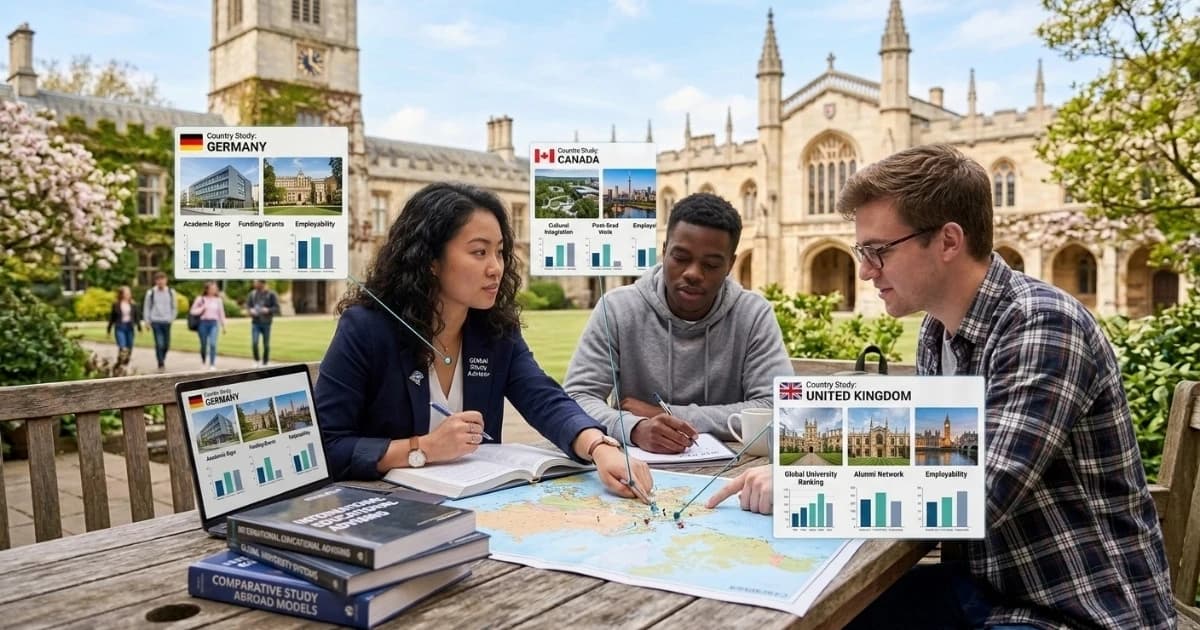
UK vs Canada vs Germany: Best Study Abroad Destination for Indian Students in 2026
Confused between UK, Canada, and Germany? We compare all three across tuition costs, post-study work rights, PR pathways…

Top Universities in Germany for Indian Students 2026
Germany's top universities offer world-class engineering, sciences, and business programs — largely tuition-free. This g…
Latest Germany Updates
All NewsGS Study Abroad Places 500+ Students in the 2025–26 Academic Year
Our team successfully guided over 500 students to universities across Germany, Canada, UK, Australia and Ireland — our biggest intake year yet.
DAAD Scholarship Applications Now Open for the 2026–27 Batch
Germany's prestigious DAAD scholarships are open for applications. Eligible students can receive full funding including tuition, stipend and health insurance.
UK Announces Graduate Route Visa Extension for STEM Graduates
STEM graduates from UK universities will now benefit from a 3-year post-study work visa under the extended Graduate Route, up from the existing 2 years.
Ready to Study in Germany?
Our expert counsellors will assess your profile, recommend the best universities and scholarships, and handle your complete application and visa process.
- ✓Free 30-minute counselling session
- ✓University shortlisting based on your profile
- ✓Complete visa documentation support
- ✓Scholarship identification and application
- ✓Pre-departure orientation and support
No fees · No commitment · Response within 24 hours
Start Your Germany Application
Fill in your details and we'll call you within 24 hours